Why the EU Must Push Harder on Quantum Computing Software
The Allies’ cracking of Germany’s Enigma machine altered the trajectory of World War II. Today, Europe is striving to master an even more formidable code-breaking tool — the quantum computer — but it lacks the software to make that possible.
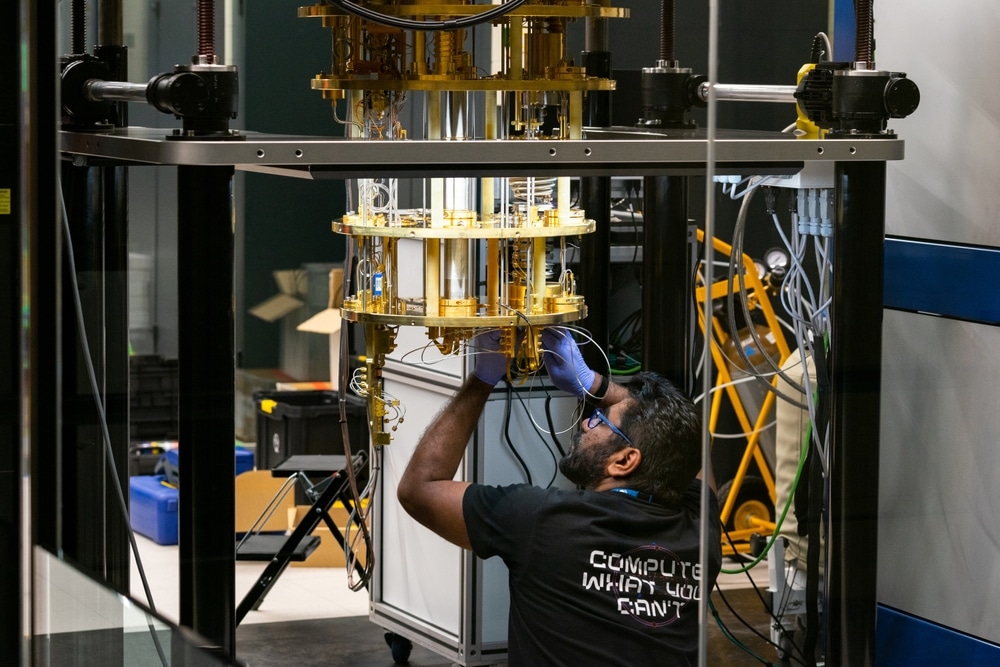
In the near term, quantum computing is poised to transform industries ranging from defense to healthcare, chemicals, and beyond, with hardware becoming increasingly available.
Yet while building physical infrastructure is one challenge, advancing the software that powers these machines is an entirely different one.
Researchers, investors, and policymakers are now turning their attention to the code inside quantum computers — technology that could eventually dismantle cryptographic algorithms at unprecedented speed and disrupt the world’s digital backbone.
Although many European developers are tackling the hardware side, the EU must prioritize software development, argues quantum engineer and researcher Olivier Ezratty.
If Europe neglects the role of quantum software
While traditional computers process information with millions of electrons as binary bits — 0 or 1 — quantum computers rely on individual particles, such as atoms or photons, as quantum bits, or qubits. These can exist in multiple states simultaneously.
It may sound abstract, but it represents a fundamental shift. The practical effect is that quantum computers can tackle certain problems far more efficiently than conventional machines — tasks that might take years on a classic computer could be solved in minutes or hours.
This exponential leap in capability is precisely why governments and corporations worldwide are treating quantum as a strategic asset. Whoever controls the software layer will not only unlock new scientific discoveries and industrial applications but will also control the tools that secure or dismantle digital security systems.
Finland’s IQM has already earned recognition for pioneering work in quantum computing. French cloud firms OVHcloud and Scaleway have connected various quantum startups’ emulators to their platforms, allowing developers to build software at a fraction of the cost. Full access to actual quantum computers is expected soon.
For Ezratty, however, these private-sector moves are insufficient to propel European quantum capabilities to a globally competitive level. In essence: Europe has companies producing everything from chips to cables to cloud access, but the vital layer of software that makes quantum machines usable remains underdeveloped.
Meanwhile, across the Atlantic, US giant IBM has released Qiskit, an open-source toolkit that helps developers learn quantum programming. This not only cultivates a workforce skilled in IBM’s tools but also strengthens early ecosystem adoption. Other companies — QC Ware in the US, Riverlane in the UK, Classiq in Israel, and Horizon Quantum in Singapore — are building their own software frameworks as well.
If Europe does not move quickly to create its own equivalents, it risks becoming dependent on foreign software ecosystems — much like it has been with cloud computing, semiconductors, and even artificial intelligence. In an era where sovereignty in technology is increasingly tied to sovereignty in economics and defense, that reliance could prove costly.
Europe’s funding challenge
So far, European support for quantum startups has been strong. But the momentum could fade, especially when compared with resources flowing outside the continent.
According to a 2024 McKinsey report, public funding accounts for 51% of quantum tech investment in the EU. In contrast, the share is just 2% in the US and 10% in the UK. Unlocking private capital has long been a challenge in Europe: between 2001 and 2023, the UK attracted 1.36 times more private investment in quantum technology than the entire EU combined.
The European Commission has also admitted the existence of a financing gap, stressing that private money is becoming the deciding factor between success and failure.
That said, some European startups have secured sizable funding. IQM has raised €200 million, while Pasqal and Alice & Bob secured €140 million and €130 million respectively. Still, compared with their US counterparts, these figures fall short. In February, US-based QuEra raised $230 million, while Maryland’s IonQ brought in $360 million.
This imbalance highlights a deeper problem: Europe is good at funding research and prototypes, but struggles to scale companies into global champions. Without stronger incentives for private investors and a more integrated single market for quantum technologies, Europe risks watching its brightest firms acquired, outspent, or sidelined.
A moment of decision
Quantum computing software may feel like a niche debate, but history suggests otherwise. The Enigma breakthrough demonstrated how mastery of code can shift global power balances. Quantum presents the same kind of inflection point, only with consequences that span every domain of modern life — from encrypted communications to drug discovery to climate modeling.
The EU has a chance to shape this frontier if it acts decisively now: by encouraging collaboration between hardware builders and software developers, by fostering open-source frameworks that rival IBM’s, and by creating funding conditions that attract not only public money but deep pools of private capital.
If Europe hesitates, the story of cloud computing could repeat itself: a continent rich in research and ideas, but reliant on foreign providers for the most critical layer of technology.
The choice for policymakers is clear: treat quantum software as a strategic priority — or watch others write the future of computing while Europe pays to license it.